High and Tight

For my father,
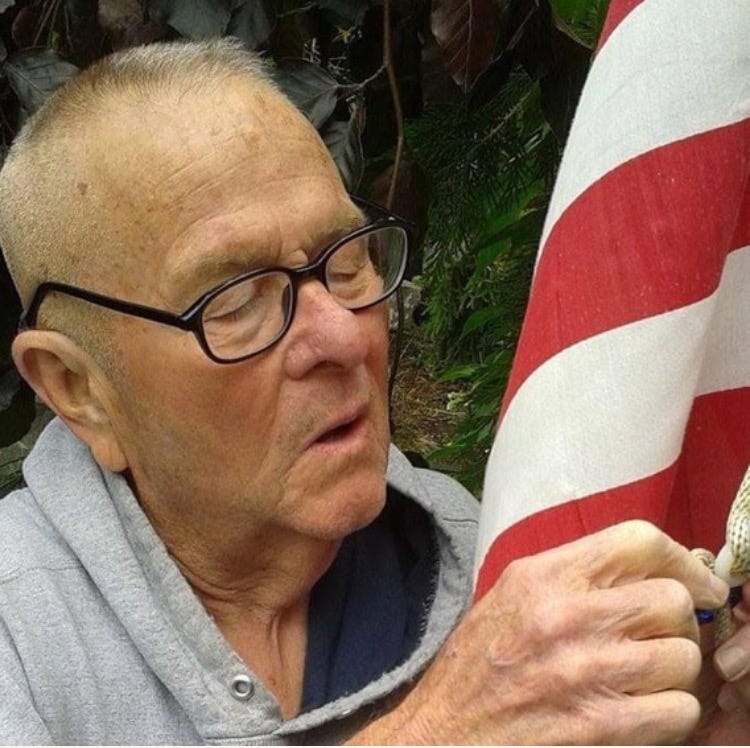
who kept the flag flying ..
In Memoriam 2026
The sound of a
lawn mower
in a place where
landscaping
has been lackluster
of late
shifts me back
to a time when
that sound was
everywhere.
Men out clipping
grass to uniform
heights, trimming
edges, sweeping,
watering,
hanging the flag
for service,
for memory,
for the ones
who didn’t
come home.
My dad kept
that ritual —
high and tight —
changing only
when nature
or my mother
put something new
in the yard
where grass
used to be.
But the flag
always flew.
Growing up
an Army brat,
the Stars and Stripes
whipping in the wind
was nothing new.
And despite
the climate now —
the ones who twist
power,
the ones who try
to claim the flag
as theirs —
they can’t have it.
I won’t let them.
It belongs
to everyone.
I’ll tuck my
organization’s hat
in a drawer
and wear something
that feels like me,
because blazing red
is not my color.
They can keep
their red hats.
They can’t have
my stars afield,
the blood‑red stripe,
the white of
what we hope
is purity —
all of it whipping
in the wind
for those who
bled and sweated
and cried
so I might enjoy
freedoms I learned to stand for
the same way he saw me stand,
even as a boy.
A flag hugging
its pole,
waiting for wind,
like leaves
in scattered light —
a reminder
of dust blowing
across whatever land
my brother lies in,
his body claimed
by the same wind
that lifts
the flag.
Am I torn
about patriotism?
Not really.
Those who call
themselves patriots —
not the football kind,
but the big‑truck,
field‑parking,
vitriol‑shouting kind —
they’re not patriots
at all.
Just boys
who never grew
into men.
Every time
I see a giant flag
bolted to a truck,
forced to fly,
I think of chains,
of slavery,
of anything but
freedom.
A flag should billow
on its own terms —
or hang still,
or rest at half‑mast
for the beloved
fallen.
Force the wind
and it’s just fabric.
A sheet.
Not a symbol.
The mower
goes silent.
My dad
comes in
to find me
showered,
combing my hair,
dressing well
for him.
Later,
I’ll sit with my mom,
both of us ready,
waiting.
But now,
he stands there —
dirty, greasy,
sweaty from acres
of cut grass,
flag hung,
tasks done
the way soldiers
do them,
retired or not.
He asks,
Will you come?
I nod,
smile,
hand him
a bottle of water.
He heads home
to prepare.
I go out,
grab the keys,
line up the truck,
warm it,
watch the flag
billow over
the koi pond,
the lawn fresh,
the sun threading
through trees.
Car ready,
I pull the keys,
knock,
go in,
sit with my mom.
And we wait
for her
Wounded Warrior —
the man who earned
the right
to raise a flag
through generations
of military men,
through the loss
of a son to war,
through childhood beatings
for his mother’s skin
but never let it
make him hard.
And I drive.
Sometimes
to Tahoma,
where parts of
my brother rest,
my eldest brother,
his best friend
meeting us there.
We stand,
imagining the roar
of high‑school crowds
from the stadium above
as he pops a beer,
pours half,
takes a sip,
hands it to Dad,
then Mom.
I raise mine
but don’t drink —
sobriety is
my freedom,
my war,
my cost.
Other days
we go to Olympia,
the Rotunda,
politicians and
armed forces
gathered.
I stand proud
when the Army stanza
rises,
soldiers singing,
and my dad —
one‑legged,
pant leg billowing —
stands tall,
chest out,
baritone ringing.
My mom
smiles at her hands.
My sister
joins when I can’t,
carrying the mantle.
He sits.
I give him
a nod,
a wink.
And that smile —
the one I’ve missed
these six years —
shines like
a light
in the dark.
The buzz,
the hum
of the cut
is gone.
All I hear
is progress
driving by.
A song
about flags
and freedom
plays in my head
as I lie in bed.
I don’t know
who cuts
my dad’s lawn now,
with the mower
I bought him.
I know my mom
still raises flags
for her grandfather,
her father,
her husband,
her son —
for all the ones
held in her memory.
So I raise
my own.
Because I know
they’re more
than sheets
in the wind.
They’re memory.
A vigilant soldier
at attention.
A sentinel.
Or whipping
in the wind —
an echo
of days
gone by.
---
Daniel/Kana
5/25/26
I’m a Bio Boy
Kana writes from the body — from queer lineage, contemplative practice, and the slow disciplines of self‑care. His work is rooted in the Northwest Radical Faeries, rose culture, and long-standing devotional traditions. He serves on editorial boards, mentors emerging writers, and works as a community connector and naqib, tending to stories and relationships with attention and relational stewardship. He currently works in community mental health, though his primary vocation remains writing, service, and community care.